KSS leadership exists to enforce standards, drive operational performance, and protect the org’s mission. Authority is paired with responsibility: if you accept a task, you own follow-through.
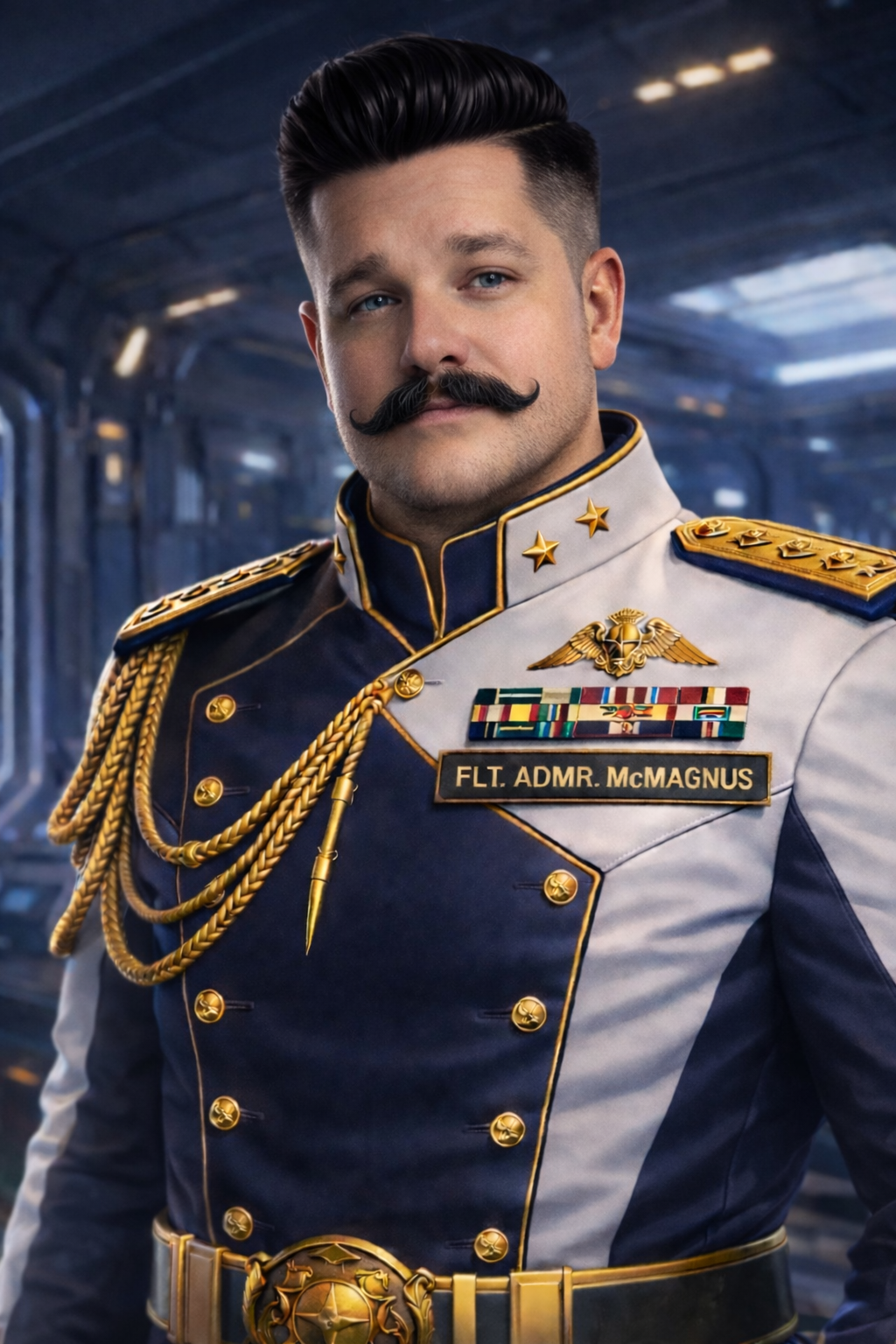
Fleet Admiral Muff McMagnus founded Kinetic Security Solutions in 2942 in response to the growing instability of interstellar trade routes and the increasing failure of conventional corporate security to counter organized piracy and hostile faction activity. A former military tactician with extensive fleet-command experience, McMagnus built KSS from the ground up as a disciplined, results-driven security organization operating under a clear chain of command. As Fleet Commander, McMagnus serves as the final authority on organizational doctrine, command appointments, and major operational deployments. His leadership philosophy is direct: structure wins fights, discipline prevents losses, and accountability ensures survival. Under his direction, KSS rapidly evolved from a small mercenary element into a high-reliability private security force trusted with high-risk escort, defense, and rapid-response contracts. McMagnus is known for decisive action, zero tolerance for operational drift, and an uncompromising standard for leadership conduct. His strategic oversight ensures that every division operates with clarity of purpose and that KSS maintains its reputation as a force that does not hesitate — and does not fail.

Vice Admiral Archbishop is a co-founder of Kinetic Security Solutions and the primary architect of its strategic planning framework. A former high-ranking official within the United Earth Empire, Archbishop brings deep experience in large-scale coordination, operational forecasting, and organizational control under pressure. As Deputy Fleet Command, Archbishop oversees org-wide operational tempo, cross-division coordination, and deployment readiness. He ensures that missions are properly staffed, objectives are clearly defined, and execution aligns with KSS doctrine. Where Fleet Admiral McMagnus sets direction, Archbishop ensures it is executed efficiently and without fragmentation. Known for methodical planning and calm authority, Archbishop is the stabilizing force behind KSS’s ability to scale operations without sacrificing discipline. His leadership ensures that when the org deploys, every role is accounted for — and no mission collapses due to poor coordination.

Rear Admiral Spectre is the architect behind KSS’s ability to operate where failure is the default. Unlike most flag officers, Spectre did not rise through command tracks or political appointments — he came up through engineering bays, salvage crews, and emergency repair teams operating under live fire. Spectre began his career as a systems engineer assigned to recovery and refit operations in unstable theaters, where ships were kept operational through improvisation, redundancy, and a refusal to abandon assets. Early after-action reports consistently cited his ability to restore propulsion, weapons, and life-support systems in environments deemed “non-recoverable” by standard doctrine. Missions continued because Spectre refused to accept that damaged meant disabled. As operational tempo increased, Spectre was repeatedly embedded with special operations units not as support, but as a force multiplier. He redesigned field-repair doctrine to function under active engagement, enabling rapid rearmament, emergency hull stabilization, and combat-capable salvage while hostile contact was ongoing. His teams became known for arriving after catastrophic losses and leaving with operational platforms — sometimes rebuilt mid-fight. Promotion followed necessity rather than ceremony. Spectre assumed command roles when engineering decisions became mission-critical, directing force movement based on what could be repaired, rerouted, or repurposed in real time. His authority expanded as commanders learned that battles were won or lost not by firepower alone, but by which side could stay operational longer. By the time he attained flag rank, Spectre had rewritten large portions of KSS’s engineering, salvage, and rapid-recovery doctrine. As Admiral, he now oversees high-risk security posture, rapid response protocols, and decisive counter-action when operations escalate beyond planned parameters. Under his command, Engineering is not a rear-echelon function — it is a front-line capability. Spectre is known for aggressive counter-action, ruthless efficiency, and an uncompromising belief that anything still transmitting can be saved — and anything that can be saved can be weaponized.

Admiral JuiceBox is one of the three founding architects of Kinetic Security Solutions, alongside Muff McMagnus and Archbishop. Where McMagnus defined intent and Archbishop shaped doctrine, JuiceBox built the machinery that turned vision into sustained action. JuiceBox rose through fleet coordination and logistics control roles where success was measured not by visibility, but by whether operations collapsed without him. Early in his career, he developed a reputation for restoring order to chaotic deployments — synchronizing units that had never trained together, rebuilding communications chains mid-operation, and reestablishing timing discipline when missions began to fracture under pressure. His defining trait was not speed, but precision under escalation. JuiceBox demonstrated an uncommon ability to maintain rally discipline and command clarity as environments transitioned from routine to hostile. Assets arrived where they were needed, when they were needed, and in the condition required to continue the fight. Units that should have drifted, stalled, or desynchronized instead stayed aligned — often without realizing how close they had come to failure. During the formative period leading to KSS’s founding, JuiceBox worked in close coordination with McMagnus and Archbishop across multiple joint operations. Repeatedly, it was JuiceBox’s deployment control, comms discipline, and task ownership frameworks that prevented mission collapse when plans met resistance. Those experiences directly informed the decision to formalize KSS around a core principle: execution matters more than intention. As a co-founder, JuiceBox designed KSS’s logistics and communications doctrine from the ground up, embedding accountability, timing control, and redundancy into every operational layer. His systems ensure that once a commitment is made, it is carried through to completion — without confusion, delay, or loss of tempo. Today, as Fleet Command and Logistics Division Commander, JuiceBox oversees full deployment execution for KSS operations. During live engagements, he enforces communications discipline, rally timing, and task ownership, acting as the stabilizing force that keeps operations coherent under fire. He is known for holding the line when deployments escalate, ensuring that teams already committed are never left unsupported. Within KSS leadership, JuiceBox is regarded as the anchor — the one who ensures that bold plans survive contact with reality.

Vacant position.

Commander TallGirl oversees all medical operations within Kinetic Security Solutions, serving as the final authority on combat medicine, trauma response, and force survivability during sustained operations. Where others focus on winning engagements, TallGirl ensures personnel survive them — and remain capable of continuing the mission. TallGirl came up through frontline medical roles where evacuation was uncertain, resources were limited, and decisions had to be made in seconds. Early assignments placed her embedded with high-risk units operating beyond reliable extraction windows, forcing her to develop treatment protocols that prioritized return-to-fight capability as much as survival. Her after-action reports consistently reflected one theme: casualties stabilized under conditions where doctrine said they should not have been. As operations escalated, TallGirl began rewriting KSS’s medical response philosophy. Rather than treating medical as a post-contact function, she integrated it directly into operational planning — synchronizing movement timelines, casualty collection points, and triage authority with command intent. Under her influence, medics were no longer reactive assets; they became anticipatory force multipliers. Her reputation solidified during multiple extended engagements where casualty rates threatened to degrade operational tempo. TallGirl coordinated live triage across dispersed units, reallocating medical assets dynamically while maintaining command visibility. In several cases, missions continued solely because her teams kept personnel alive and functional long enough to complete objectives. When KSS formalized its divisional structure, TallGirl was the unanimous choice to command Medical. She established rigorous training standards, psychological resilience screening, and uncompromising protocols for casualty accountability. Under her leadership, every loss is examined, every near-fatal is documented, and every survivable mistake is eliminated. Within KSS, TallGirl is known for calm authority under pressure and absolute clarity in crisis. When she speaks on comms, arguments stop. Commanders trust her calls because they are grounded in reality — not optimism. Her presence ensures that KSS does not confuse expendability with professionalism. TallGirl embodies a core KSS truth: missions can be replaced — people cannot.

The Weapons Division Commander serves as Kinetic Security Solutions’ final authority on armament selection, fire control doctrine, and the ethical application of force. Where others decide where and when to fight, this role determines how violence is applied — and when it must stop. Rising through weapons testing, field integration, and live-fire evaluation roles, the Commander built their reputation not on destruction, but on control. Early deployments placed them alongside mixed-unit teams operating with inconsistent weapons platforms and unclear engagement authority. Repeatedly, they identified that mission failures were not caused by insufficient firepower — but by poorly governed lethality. Their early work focused on standardizing weapons employment under stress: simplifying fire control logic, clarifying escalation thresholds, and eliminating ambiguity around engagement authority. The result was a measurable reduction in collateral damage, ammunition waste, and friendly-force risk — without any loss of operational effectiveness. As KSS operations expanded into higher-risk contracts, the Commander was embedded directly into planning and execution cycles, advising leadership on loadouts, rules of engagement, and escalation ladders tailored to mission intent. Their guidance ensured that force applied was decisive, not reactive — overwhelming when required, restrained when advantageous. Upon assuming command of the Weapons Division, they formalized KSS’s lethality governance framework, integrating weapons selection, training standards, and post-engagement review into a single accountability loop. Every discharge is intentional. Every deviation is examined. No weapon enters service without doctrine, and no doctrine exists without enforcement. Within KSS, the Weapons Commander is known for measured judgment and absolute intolerance for indiscipline. They do not glorify violence — they control it. Their presence ensures that KSS remains feared by adversaries, trusted by clients, and defensible under scrutiny. The Weapons Division operates under a simple truth established by its Commander: precision is professionalism — excess is failure.
Vacant position.
Leadership is not a title - it is responsibility. Every command slot exists to make the org more effective: faster deployments, cleaner comms, better coordination, and stronger follow-through. We win by discipline.